WELCOME TO THE WORLD OF ARTISANAL FASHION PRODUCTION


Fabric & Fit
What Is Hollow to Hem? Dress-Length Measurements Explained
Understand hollow-to-hem, hollow-to-floor and other length references, why they are not interchangeable, and what to confirm before submitting a custom dress measurement.
On this page
Hollow to hem is a dress-length reference from the hollow at the base of the neck to the hem position. It is not your full height, not a waist-to-floor measurement, and not a shoulder-to-hem measurement. Before using a number, check the maker's diagram, the stated endpoint and whether shoe allowance is already included.
The distinction matters because some size charts provide hollow-to-hem as a finished-length reference, while a custom-order form may ask for a different body measurement. Do not transfer a number between fields simply because both relate to dress length.
Where is the hollow?
The hollow is the small dip at the front base of the neck, between the collarbones. It provides a reference point even when a garment's visible neckline is much lower, asymmetric or strapless.
Sydney's Closet's measuring guide describes hollow-to-hem from this point to the hem and recommends having someone help take the measurement. Use such guidance to understand the term; follow your own dress maker's instructions for the actual order.
Shoulder to hem is a different reference
A dress length measured from the shoulder's high point near the neck to the bottom hem is commonly called High Point Shoulder to Hem (HPS to Hem), rather than Hollow to Hem. For example, Reckless Ericka's size guide identifies its dress lengths as high-point-of-shoulder-to-hem measurements. The shoulder high point and the front neck hollow are different starting points.
LOOKE's shoulder-top-to-hem garment-length reference is recorded without adding a separate shoe-height allowance. This describes how that garment length is recorded; it does not mean every retailer's Hollow to Hem chart excludes a heel allowance. Check the specific chart or order instructions.
Compare the main dress-length terms
| Term | Reference points | Important distinction |
|---|---|---|
| Hollow to hem | Front neck hollow to the stated hem position. | May be a charted length reference or a requested measurement. Check which, including any allowance. |
| Hollow to floor | Front neck hollow to the floor. | Not automatically the finished dress length. Follow the specified shoe method. |
| Height | Top of the head to the floor. | Starts above the hollow. LOOKE's retail guide asks for height without shoes. |
| Waist to floor | Specified waist reference to the floor. | Starts lower than the hollow; confirm the precise waist reference and method. |
| Waist to Feet — LOOKE form | The requested waist-to-feet length, with the customer's planned shoe height included. | LOOKE requires shoe height to be added for this entry. Do not add the same allowance twice or substitute a shoulder or neck measurement. |
| High Point Shoulder to Hem | Shoulder high point near the neck to the stated bottom hem. | LOOKE records this garment length without adding a separate shoe-height allowance. The starting point is not the front neck hollow. |
| Strap to hem | A specified point on a strap to a named hem. | Confirm the strap position and adjustment. It is not automatically HPS to Hem or Hollow to Hem. |
| Train length | Depends on the maker's stated reference points. | A trailing back section is not described fully by a front hem measurement. |
The Waist to Feet label in LOOKE's applicable Custom Size form must not be silently relabeled as Hollow to Hem. Include the customer's planned shoe height in that requested value. Where the selected style does not explain the exact waist reference, endpoint or tape route, contact LOOKE before completing the field.
Are you reading a chart or submitting a body measurement?
A size chart can give a number to help you picture where a finished dress will fall. A custom form, by contrast, asks you to provide information that will be used in preparing your order. Those two uses are easy to confuse.
For example, Azazie's measurement explanation distinguishes the hollow-to-floor body measurement used in its custom process from the hollow-to-hem information provided for standard dresses. That is a brand-specific example, not a universal custom-order form.
Before copying a number, identify its label and purpose. Do not put a standard chart's dress length into a field asking for your body measurement. Likewise, do not use your full height as a shortcut when the required measurement begins below the head.
Should heels be included?
There is no single allowance to add to every maker's length measurement. A chart may already include an allowance, while a custom service may request barefoot measurements and shoe information separately. Adding extra length without checking can count an allowance twice.
LOOKE's confirmed rule for Waist to Feet is to add the customer's planned shoe height. Include that shoe-height component only once. Keep the original measurement and the shoe height identifiable when asking for help, and state whether the submitted total already includes it. If you measured while wearing shoes, explain that to LOOKE rather than automatically adding another shoe-height allowance.
Keep this separate from two other records: your height without shoes and the shoulder-top-to-hem length of the garment. LOOKE's shoulder-top-to-hem garment length does not receive a separate shoe-height addition. Do not automatically add the same amount to every field.
The retail Size Guide remains the general reference for body sizing. For an additional style-specific length, confirm the exact starting point, endpoint and tape route. Do not assume those details are identical to another retailer's process.
Tell LOOKE which shoes you intend to wear, especially when you may change shoes during the event. The value should be accompanied by its unit and whether it already includes shoe height, rather than an unexplained number.
How to confirm a requested length before measuring
- Identify the exact dress and color. Send its product link rather than a similar reference image alone.
- Confirm the starting point. Ask whether it is the neck hollow, natural waist, shoulder or another stated location.
- Confirm the endpoint. Distinguish the floor, front hem, shortest side, back hem and end of a train.
- Confirm the route and record the shoe treatment. Follow LOOKE's shoe-height inclusion rule for Waist to Feet, and state whether your submitted value already includes it. For other length fields, follow their own instructions.
- Record the unit and method. Keep the original measured value and any specified shoe-height addition identifiable. Describe a requested fit change separately.
When measuring vertically, having another person assist can help avoid changing your posture while reading the tape. Recheck an uncertain result instead of replacing it with a value estimated from your height.
Why an asymmetric hem or train needs more context
The Eos strapless midi has an intentionally uneven waterfall hem. Asking only for its longest point would not tell you how high the opposite side sits. A coverage question should identify the shortest area as well.
The Love Gown has an extended train, while the Venus Wet Look Dress has a fishtail train. In each case, the length needed at the front and the trailing effect at the back are different concerns. Do not assume a custom front length also specifies a particular train length or that every train alteration is available.
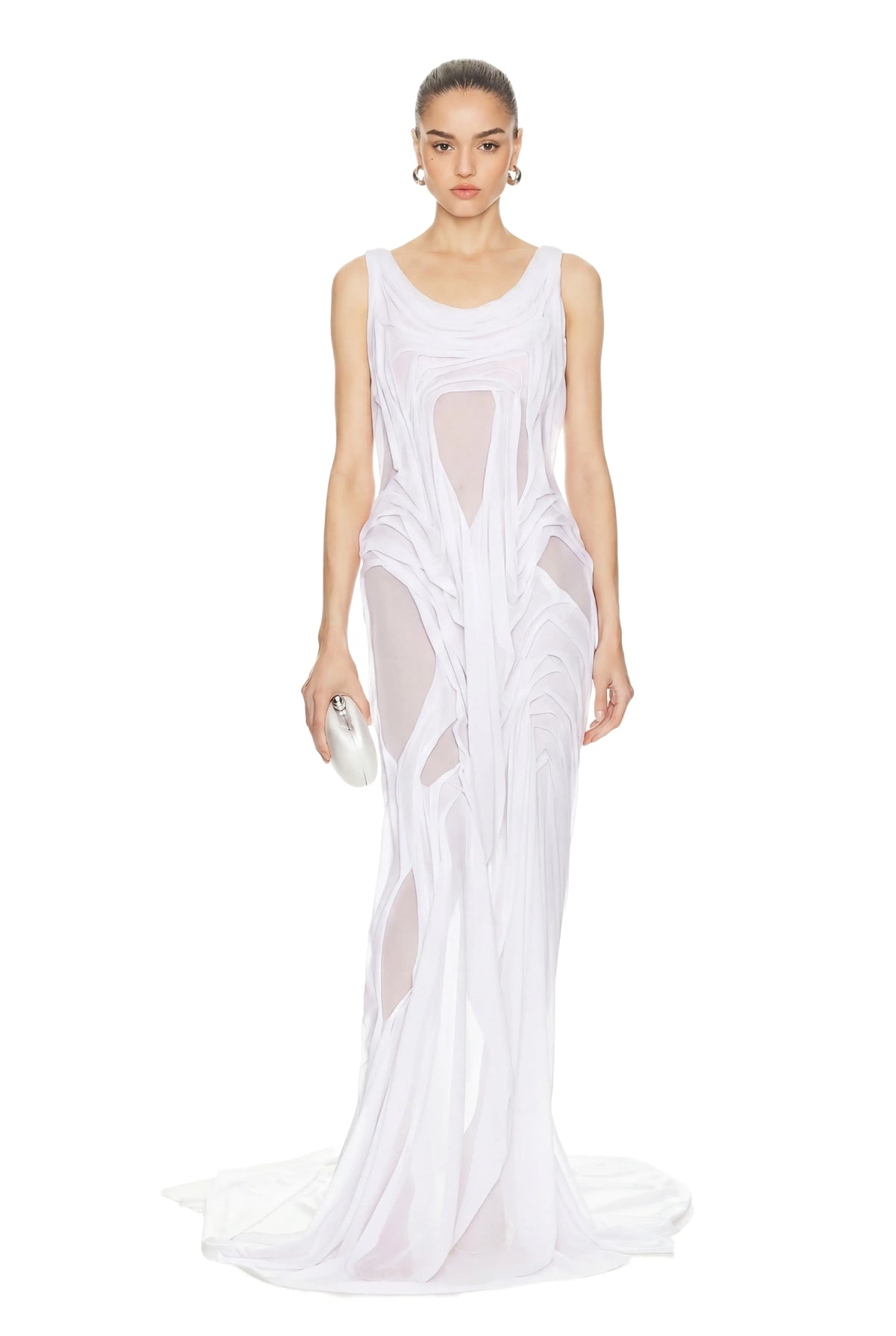
The catalogue photographs on this page illustrate silhouettes. They do not establish a numeric measurement, a measuring route or a guaranteed hem position on a different person.
A useful length enquiry
You can prepare a message like this:
My selected product is [product link], in [color]. My height without shoes is [number and unit], and my planned shoe height is [number and unit]. For Waist to Feet, my submitted value is [number and unit], and it [already includes / does not yet include] the shoe height. I would like guidance on the [front hem / shortest side / train]. Please confirm the starting point, endpoint and tape route for my selected style before I finalize the measurement.
Send it through Contact Us. For a fixed event date, include your destination and deadline, but keep those details separate from garment length.
Common questions
Is hollow-to-hem the same as height?
No. Height begins at the top of the head. Hollow-to-hem begins at the front neck hollow and ends at the stated hem position.
Is hollow-to-hem the same as shoulder-to-hem?
No. Hollow-to-hem starts at the front neck hollow, while shoulder-to-hem starts at the specified shoulder point. Use the measurement name that matches the actual starting point.
Is hollow-to-hem the same as waist-to-floor?
No. The starting points differ, and the endpoints may differ too. They cannot be substituted without a specifically defined method.
Should I include my shoe height in LOOKE's Waist to Feet entry?
Yes. Include the planned shoe height once in that requested value. State whether your value already includes it, and ask LOOKE before adding anything further to a measurement taken while wearing shoes.
Should every floor-length dress touch the floor?
Not necessarily in the same way. The intended silhouette, shoes, front clearance and any train affect the decision. Discuss the desired result for the actual dress rather than using one universal rule.
Can I enter hollow-to-hem in LOOKE's Waist to Feet field?
No. Do not substitute it. The start point is different, and LOOKE's Waist to Feet value must include the customer's planned shoe height.
Sources and scope: Terminology references are linked above. LOOKE's shoe-height rule for Waist to Feet and its shoulder-top-to-hem garment-length convention were confirmed by the store owner on October 7, 2026. These are LOOKE-specific instructions, not universal definitions of another retailer's measurements. This article does not replace a style-specific diagram or measuring instruction.
Explore the pieces